
In recognition of the distinguished service of Sue Kopp, we dedicate to her this Torah exhibit on the occasion of her retirement. Her contribution to Warner Pacific College will be long remembered.
1. SEPHARDIC TORAH SCROLL (19th Century)
Each column of the scroll has been photographed and indexed. View or download the images.
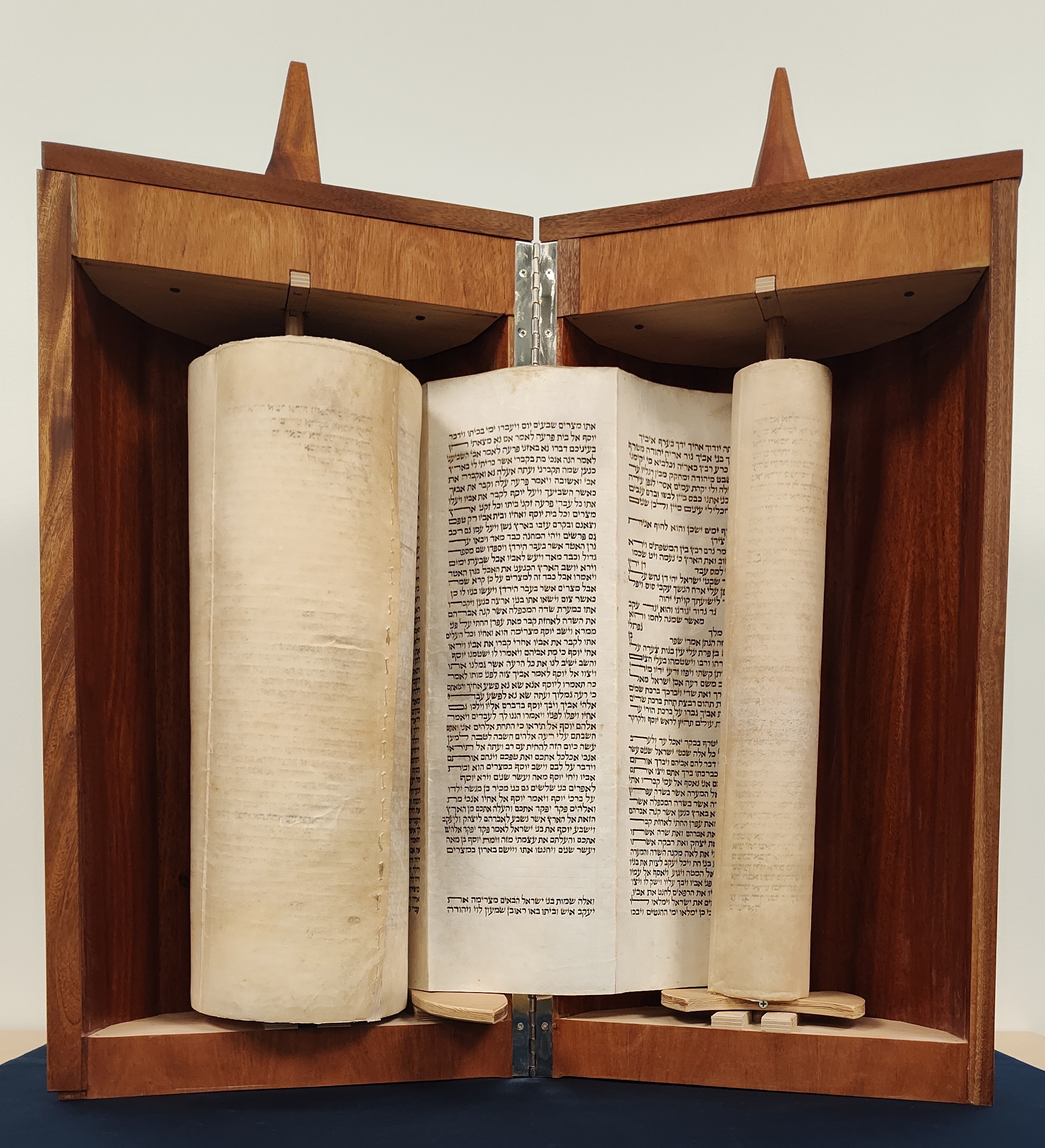
This Sefer Torah (Torah Scroll) was donated to Warner Pacific College by Allan and Cynthia Boyce. It is housed in a Sephardic Torah Ark which was custom made by Brendan Murphy, owner of Substrata Creative Studios and alumnus of Warner Pacific College. The scroll consists of pages of kosher sheepskin parchment which have been sewn together with giddin (special, treated sinews, from a kosher animal). The ark is carved from Khaya wood.
The term “Sephardic” describes a specific style of Sefer Torah that stands upright in a hard case as opposed to the Ashkenazi tradition of a rolled scroll with a cloth cover. Sefer Torahs are wound around two wooden rollers (called Atzei Chayim, or “trees of life”) which are attached to either end of the scroll. Sephardic Torahs are then stored in a special cabinet called an “ark” (a shortened form of Aron Kodesh which means “holy cabinet”).
The Torah is the first five books of the Hebrew scriptures (called Tanakh). Torah means “teaching,” “instruction,” or “direction.” The book of Proverbs (Mishlei) contains a poem dedicated to the greatness of wisdom which declares: “It is a tree of life to those who hold on to it, and everyone who takes hold of it will be blessed” (Proverbs 3:18). Therefore, Jewish tradition equates Torah with wisdom, and “Tree of Life” has become a metaphor both for the Torah itself and for the wooden rods used to roll it. In the Tanakh (Hebrew scriptures) the Tree of Life represents not only immortality (Genesis 3:22), but also divine wisdom and spiritual nourishment (Proverbs 3). Studying the Torah leads to divine wisdom and spiritual nourishment. Ultimately, the Torah points the way to eternal life. After reading from the Torah many congregations will sing, “It is a tree of life to those who hold on to it,” when it is returned to its protective ark. Rabbi Daniel Kohn provides additional details about The Torah Service.
A standard Torah consists of 304,805 letters. The scribe (sofer) uses a quill and special ink to handwrite each letter in Hebrew calligraphy. More than 4,000 Judaic laws and rules (halachot) dictate the detailed technical specifications required to produce a Sefer Torah. These include the exact width of columns and margins–even the spaces between letters and words. Every letter must be perfectly formed, and no letter may touch another letter. Nothing can be written from memory. Every letter must be copied from a validated master text known as a Tikkun.
In Jewish tradition, Hashem (meaning “The Name”) actually has many different names which reflect God’s divine attributes. However, seven of these names are considered to be so holy that they can never be erased once they have been written. The seven holy names of Hashem are:
- The Tetragrammaton (יהוה): The “Explicit Name” of God and the most sacred of all names
- Adonai (אדני): Meaning “My Lord” or “Master”
- El (אל): Meaning “God” or “Mighty One”
- Eloah (אלוה): The singular form of “God”
- Elohim (אלהים): The most common name for God in the Torah, denoting His role as both Creator and Judge
- Shaddai (שדי): Often translated as “Almighty”
- Tzevaot (צבאות): Meaning “Lord of Hosts”
If a mistake is made while writing any one of these seven holy names of Hashem then the entire page of parchment must be buried. In Rabbinic Judaism, writing Hashem is so critically important that a special set of rules and practices applies specifically to this process.
- Customarily a scribe will immerse himself in a mikvah (ritual bath) at the beginning of the day, especially before writing God’s name, to ensure he is in a state of spiritual purity.
- Before writing Hashem, a scribe must verbally declare his intent to sanctify the Name. This is to distinguish this particular use of the Name from a secular use and also to avoid writing the Name in vain. The scribe will often declare his intent by saying out loud, “L’shem K’dushat HaShem” (For the sake of the holiness of the Name).
- In addition, after speaking his declaration of intent, a scribe may wash himself ritually to elevate the act of writing to a sanctified act of devotion.
- After dipping his pen in ink, a scribe should write at least one letter of a preceding word before beginning to write the sacred Name. This ensures that the pen does not “bloat” or drip ink onto the sacred Name.
A Sefer Torah typically takes 12-18 months to complete. For more information about this detailed process, read The Making of a Torah Scroll.
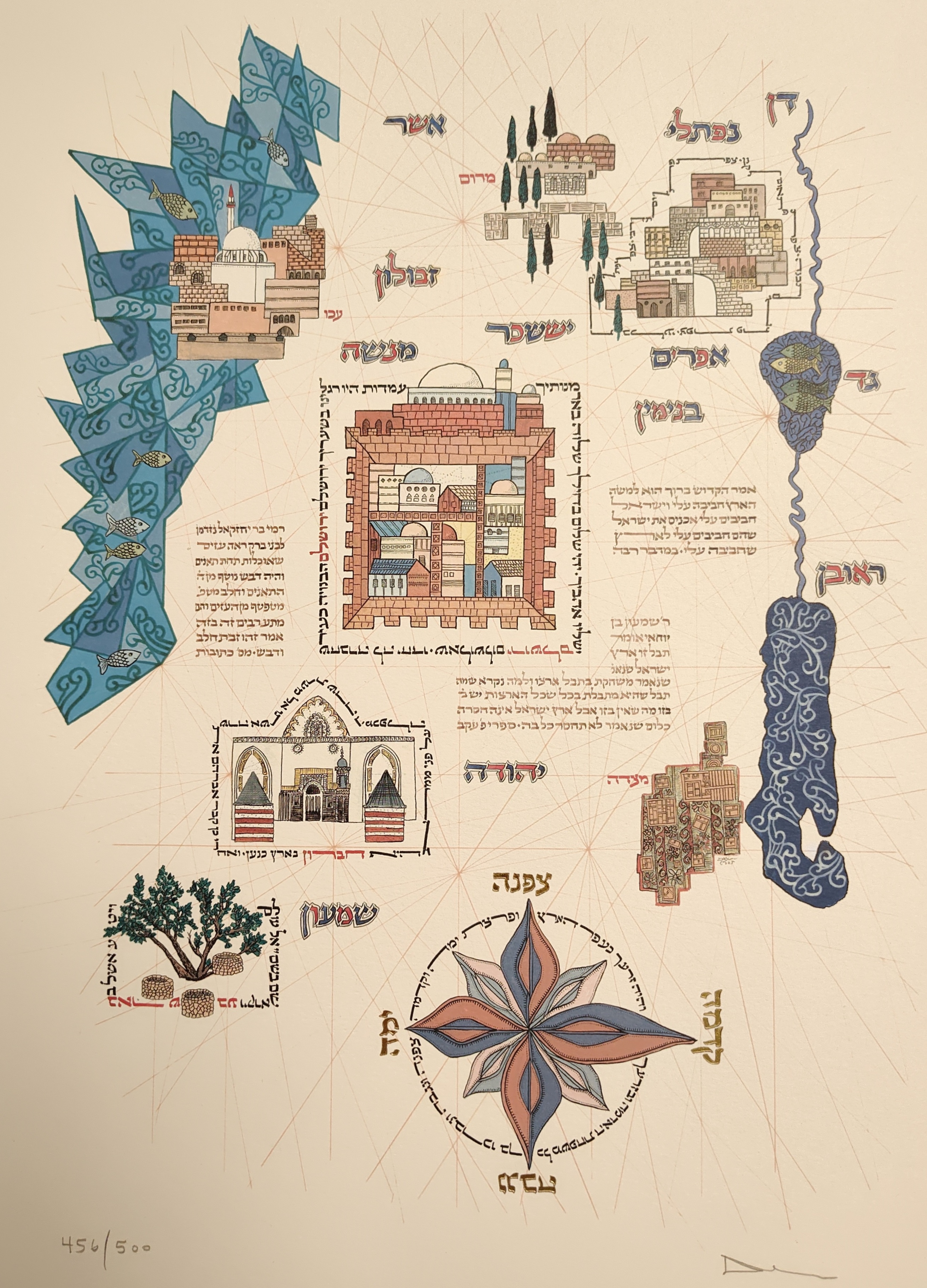
2. DREAM MAP of ISRAEL
Artist: David Moss
Donated By: Robin Gordon and Terry Baker
Read more about this Dream Map of Israel
 .
.
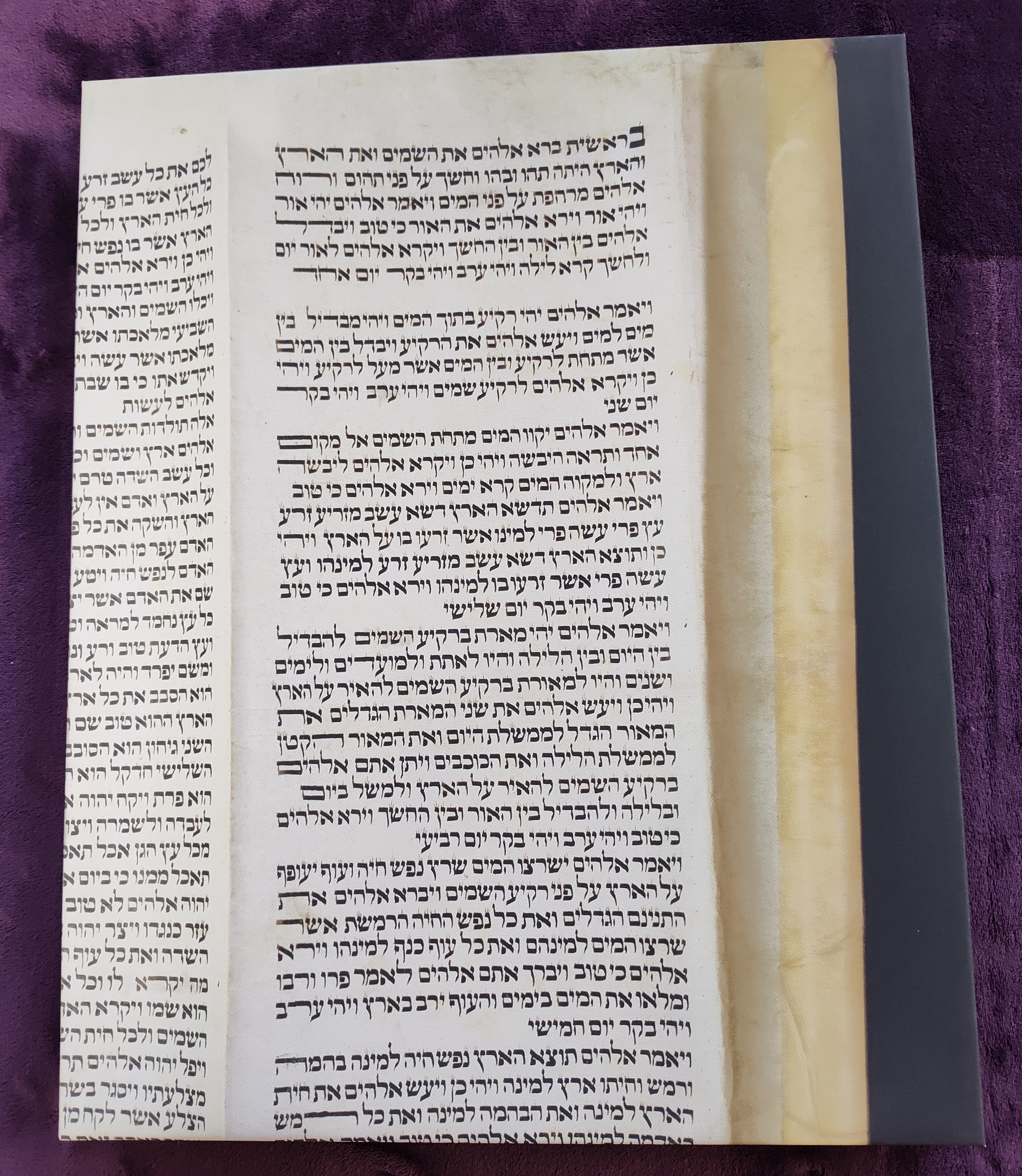
3. View of SEPHARDIC TORAH: The Story of Creation (column 1)
First Verse: Genesis 1:1 (Bereishit 1:1)
Last Verse: Genesis 1:29 (Bereishit 1:29)
Additional Information:
- This is the start of the scroll. Hebrew is written and read from right to left. The right side of the scroll is attached to the wooden rollers (the Atzei Chayim).
- This text is written in Assyrian Script (Ktav Ashurit), the traditional calligraphic script used for sacred scrolls.
- The scribe used a large letter “Bet” (ב) to start the first word, Bereishit. This is traditional in Torah scrolls to mark the very beginning of the Five Books of Moses.
- Tagin are small, decorative crowns or daggers placed above seven Hebrew letters (ש, ע, ט, נ, ז, ג, צ). Many Jewish traditions consider them necessary for a scroll to be considered kosher. Some people think these are the “tittles” referred to by Jesus during his Sermon on the Mount (Matthew 5:18).
- This column is written in standard block prose. Some letters like the He (ה) or Lamed (ל) are used as fillers by stretching them horizontally. This technique is used by scribes to ensure the left margin remains straight or justified. It is a hallmark of professional Torah calligraphy.
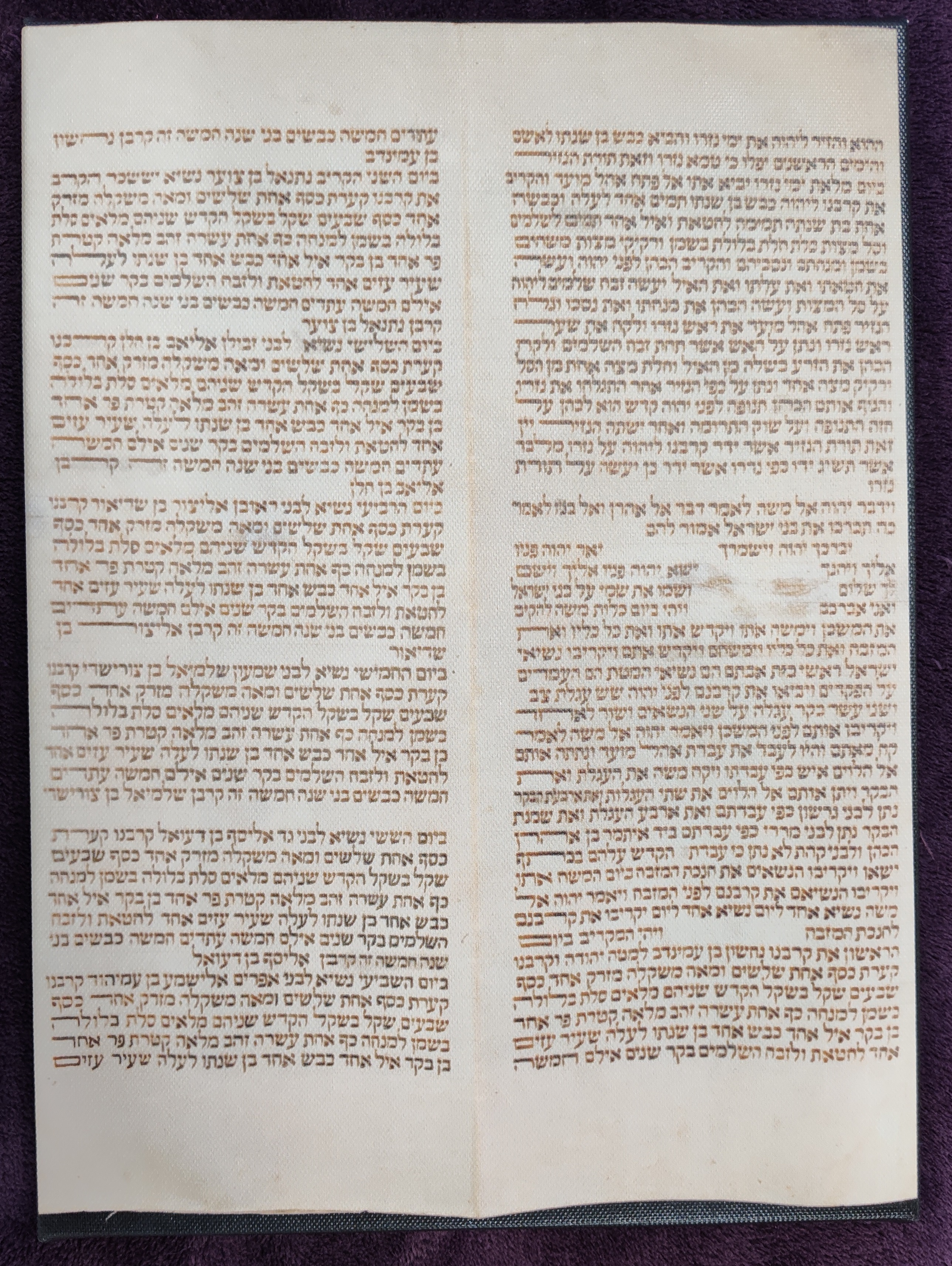
4. View of SEPHARDIC TORAH: The Priestly Blessing (columns 143-144)
Column 143 (right) First Verse: Numbers 6:12 (Bamidbar 6:12)
Column 143 (right) Last Verse: Numbers 7:17 (Bamidbar 7:17)
Column 144 (left) First Verse: Numbers 7:17 (Bamidbar 7:17)
Column 144 (left) Last Verse: Numbers 7:45 (Bamidbar 7:45)
Additional Information:
- Near the middle of the right column, this section contains the well-known Priestly Blessing (Numbers 6:24-26):
- May the Lord bless you and keep you.
May the Lord make His face shine upon you.
May the Lord lift up His countenance upon you and give you peace.
- May the Lord bless you and keep you.
- Counting down from the top, the blessing starts on line 21. Indented text makes the Priestly Blessing stand out from the surrounding prose. In Hebrew, it reads:
- Line 21 (3 words, 15 letters): יְבָרֶכְךָ יְהוָה וְיִשְׁמְרֶךָ (3
Line 22 (5 words, 20 letters): יָאֵר יְהוָה פָּנָיו אֵלֶיךָ וִיחֻנֶּךָּ (5
Line 23 (7 words, 25 letters): יִשָּׂא יְהוָה פָּנָיו אֵלֶיךָ וְיָשֵׂם לְךָ שָׁלוֹם
- Line 21 (3 words, 15 letters): יְבָרֶכְךָ יְהוָה וְיִשְׁמְרֶךָ (3
- The scribe uses this structure to represent the expansion of God’s blessing.
- A large blank space (a Petuchah) immediately follows these three lines of text. This signifies a major pause before the text transitions to the next topic (the tribal offerings).
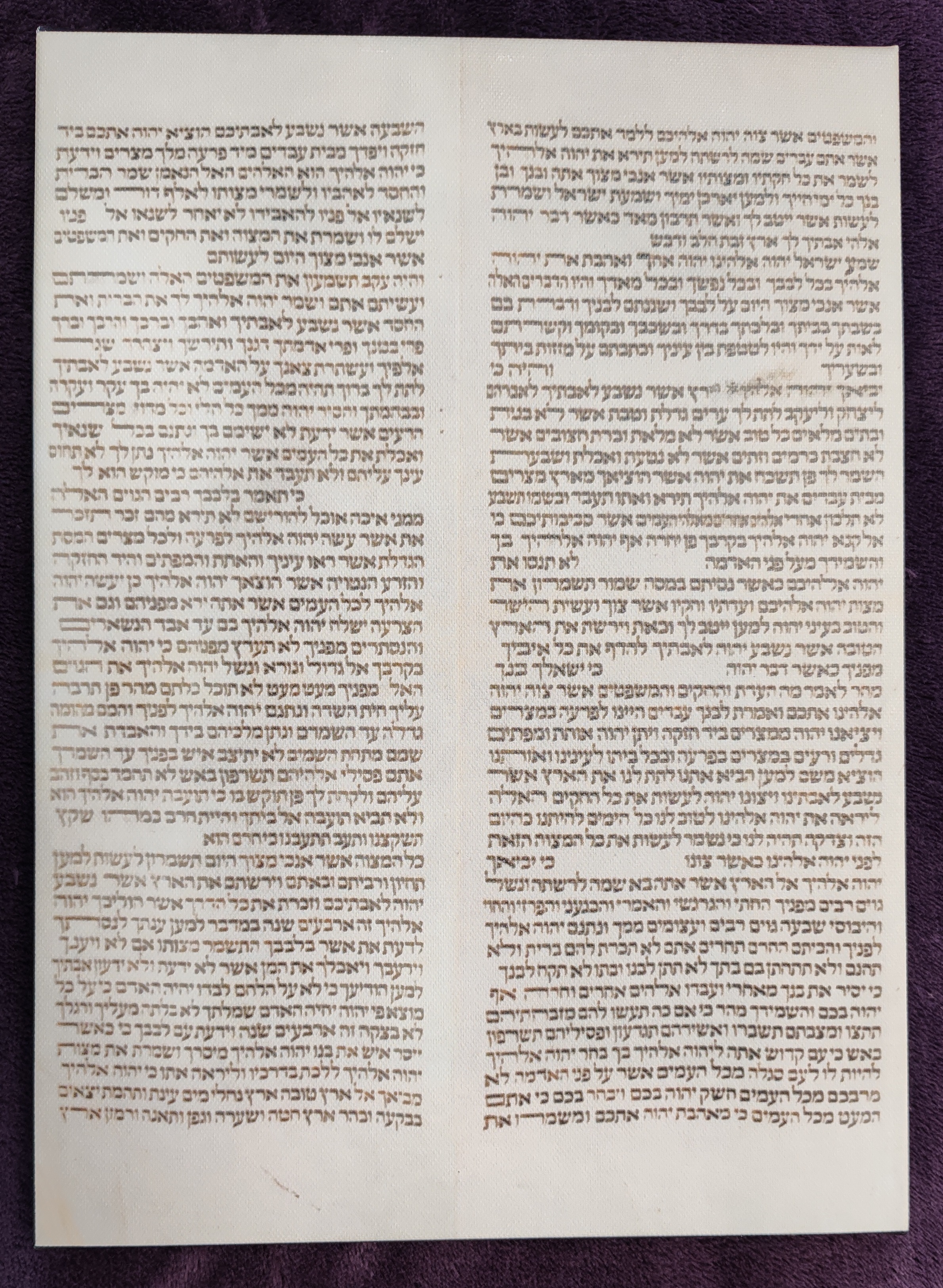
5. View of SEPHARDIC TORAH: The Shema (columns 187-188)
Column 187 (right) First Verse: Deuteronomy 6:1 (Devarim 6:1)
Column 187 (right) Last Verse: Deuteronomy 7:8 (Devarim 7:8)
Column 188 (left) First Verse: Deuteronomy 7:8 (Devarim 7:8)
Column 188 (left) Last Verse: Deuteronomy 8:8 (Devarim 8:8)
Additional Information:
- In the right column, ten lines down from the top, this section of the scroll contains The Shema.
- This column is written in standard block prose. Some letters like the He (ה) or Lamed (ל) are used as fillers by stretching them horizontally. This technique is used by scribes to ensure the left margin remains straight or justified. It is a hallmark of professional Torah calligraphy.
- The line directly above the Shema (line 9) ends early, leaving a large blank space on the left side of the column. This is a Petuchah (open paragraph break) used to signal the beginning of an extremely important declaration: Hear, O Israel: The Lord our God, the Lord is one. (Deuteronomy 6:4)
- The Hebrew text reads: שְׁמַע יִשְׂרָאֵל יְהוָה אֱלֹהֵינוּ יְהוָה אֶחָד
- The first word of this verse, Shema (שְׁמַע), means “hear” or “listen.” The last word of this verse, Echad (אֶחָד), means “one.”
- The Visual Witness: The last letter (Ayin, ע) of the first word, “Shema,” and the last letter (Dalet, ד) of the last word, “Echad,” are intentionally enlarged by the scribe to emphasize them. Together, these two enlarged letters spell the Hebrew word “Ed” (עד), which means “witness” and visually signifies that the reader is a witness to God’s unity when these words are recited.
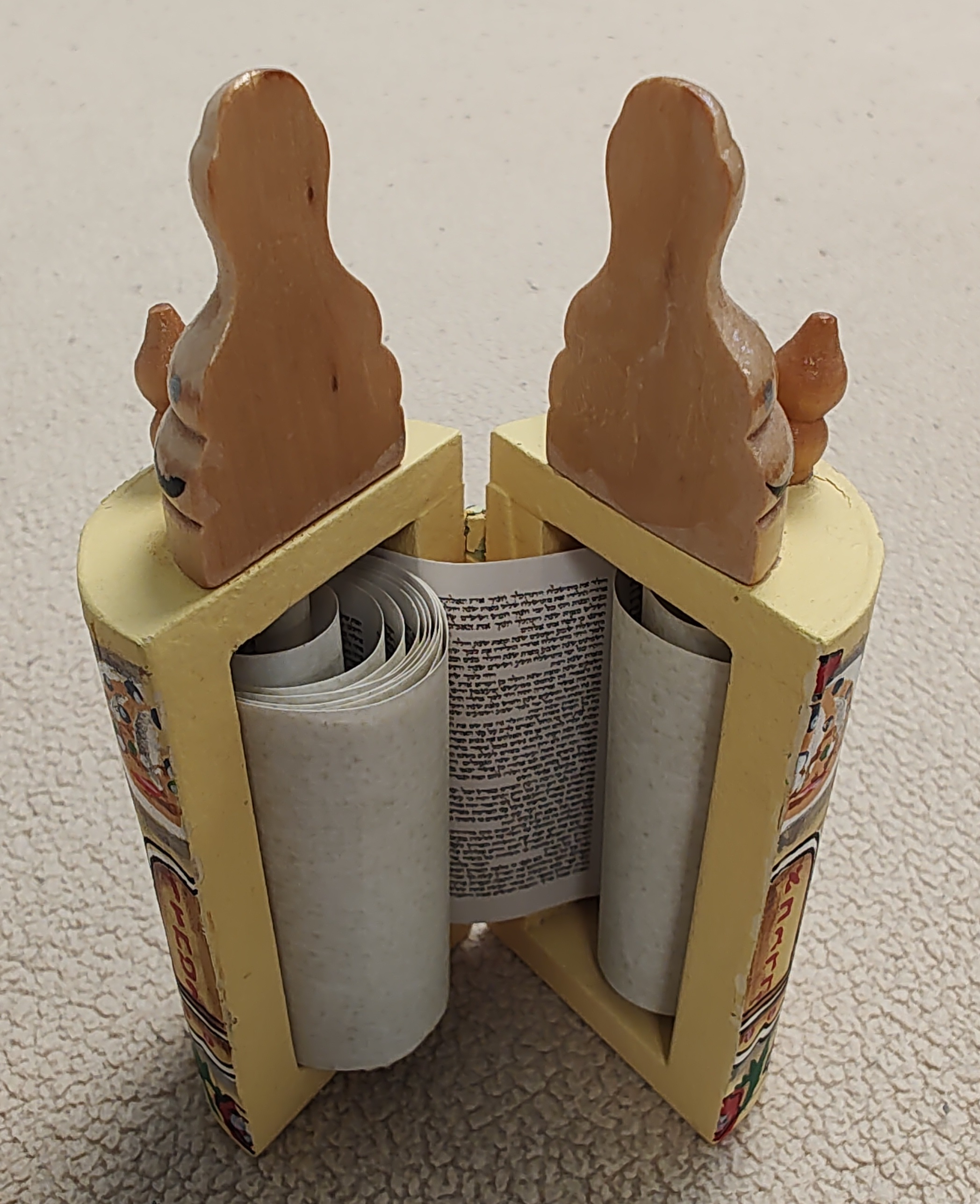
6. MINIATURE SEPHARDIC TORAH ARK
7. TALLIT (Prayer Shawl)
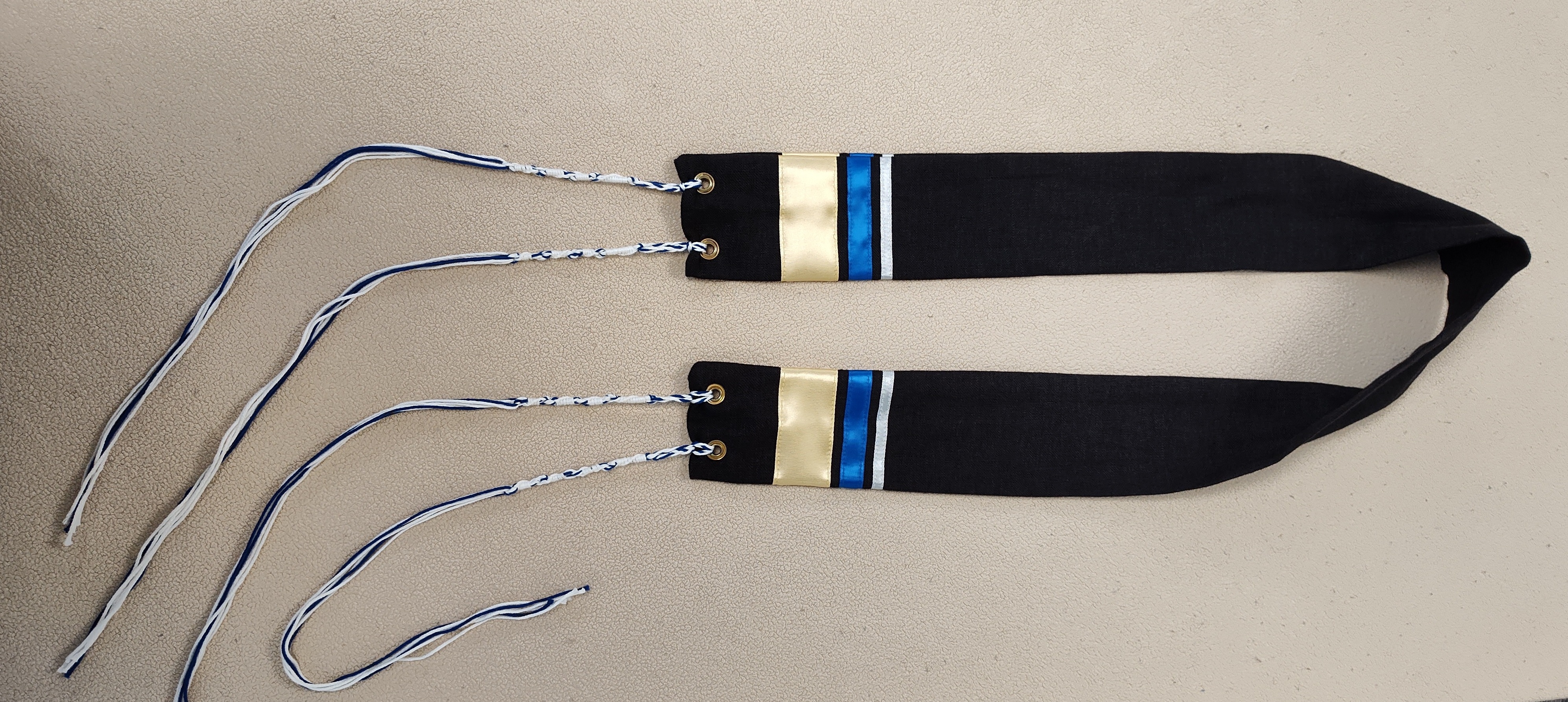
Traditionally, Jewish men (from the age of 13) will drape a tallit (טַלִּית) over their shoulders during weekday morning prayers and all day on the holiest day of the Jewish year (Yom Kippur, the Day of Atonement). However, a tallit may be worn or used on many other occasions as well. For instance, many Jewish weddings will often use a tallit for a wedding canopy (huppah).
As is typical with Jewish ceremonial objects, the tallit is steeped with symbolism. A tallit is a rectangular cloth garment with tassels, called tzitzit (צִיצִית), attached to each of its four corners. When worn, a tallit is draped over one shoulder with two corners in front and two corners in back. It is not draped across the shoulders like a graduation stole or sash. The Torah contains 613 commandments, and the tzitzit serve as a reminder to obey the Lord’s commandments (Numbers 15:37-41; Deuteronomy 22:12).
Each tassel (tzitzit) consists of eight strings and five knots. This combination of tight knots and loose strings is a reminder that our work in the world is unfinished. Even the colors of the tassels is significant. The detail of including blue thread among the tassels is described in Numbers 15:38. The white thread represents purity while the blue thread (the color of both the sea and the sky) is intended to focus our attention on God. For more information about the tallit, see Tallit: The Jewish Prayer Shawl or The Deeper Meaning of Tallit.
8. TORAH YAD (pointer used for reading)
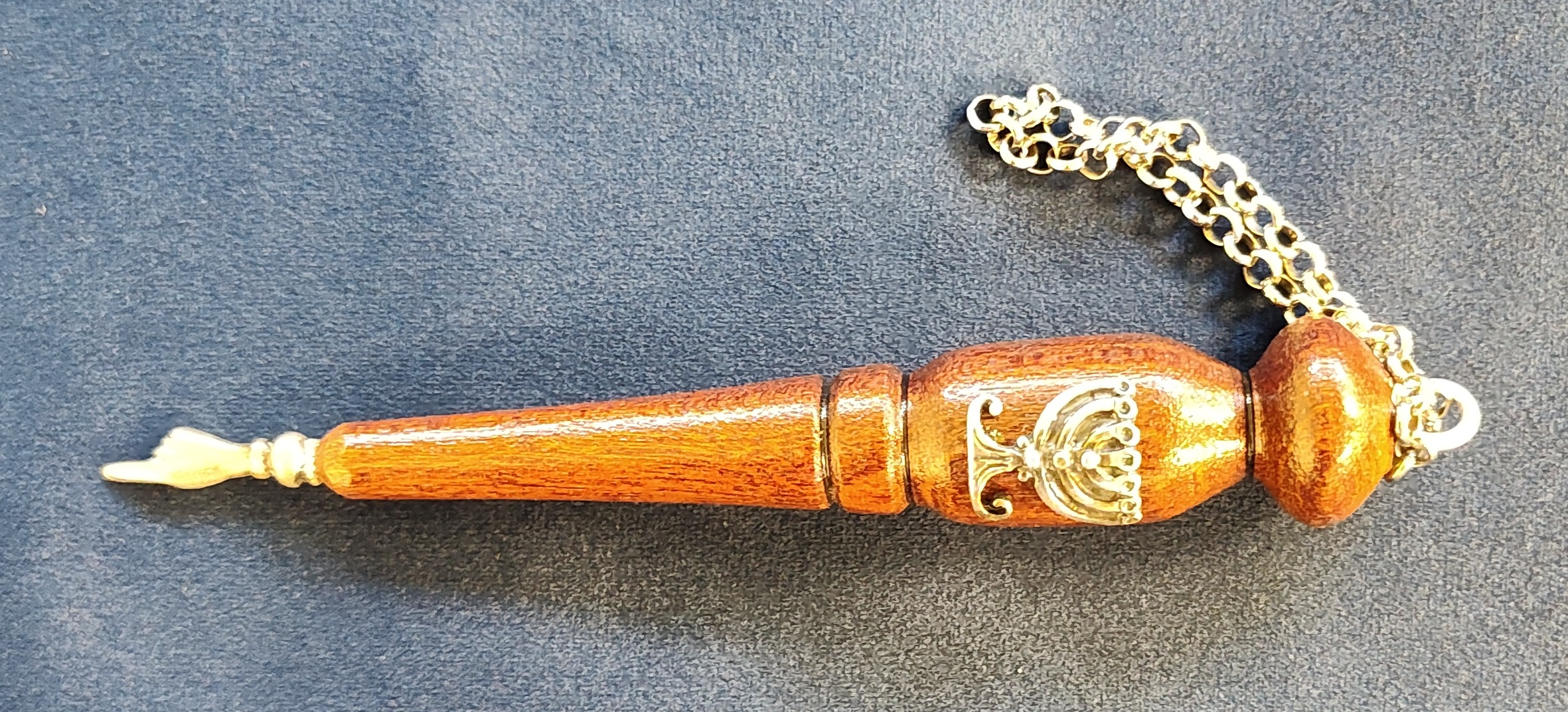
A Sefer Torah is not supposed to be touched directly. Therefore, a yad is used when reading the Torah.