
DREAM MAP of ISRAEL (with translations)
Artist: David Moss
Donated By: Robin Gordon and Terry Baker
The Dream Map is created in a medieval style and features designs and text referring to the land and cities of Eretz Yisrael. The blue and red names are the tribes of Israel in their historic locations. The seas and cities are depicted and biblical and Talmudic text are inscribed.
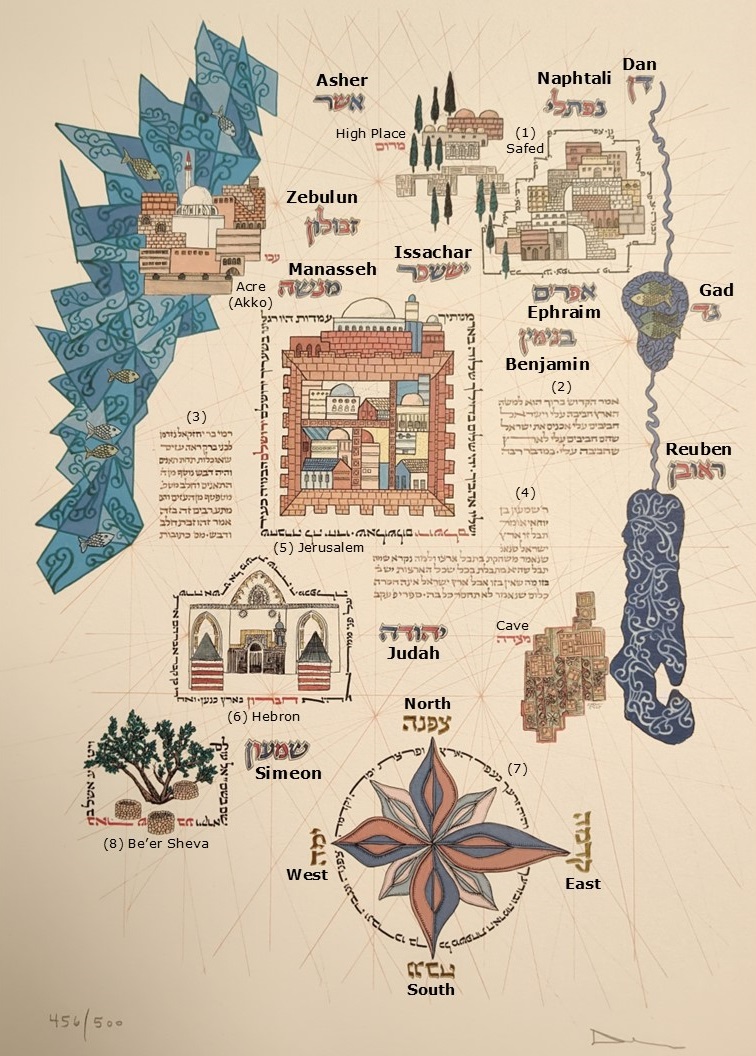
(1) – Location: Safed. These are the 1st, 4th, 5th, and 6th lines of a lament written by Rabbi Yisrael in 1837.
Rabbi Yisrael’s lamentation written for the victims of the Great Galilee Earthquake of the year 5597 (1837):
Hebrew:
צפת פתאום תחרבי
צפת פתאום תמותי
צפת פתאום תצעקי
צפת פתאום תבלעי
צפת פתאום תבנה
צפת פתאום תכונן
צפת פתאום תקדם
צפת פתאום תגן
English:
Safed, suddenly you shall be destroyed,
Safed, suddenly you shall die,
Safed, suddenly you shall cry out,
Safed, suddenly you shall be swallowed up.
Safed, suddenly you shall be rebuilt,
Safed, suddenly you shall be established,
Safed, suddenly you shall be advanced,
Safed, suddenly you shall be protected.
Additional Notes:
- Rabbi Yisrael of Shklov (1770–1839) was a Lithuanian Talmudist who led the disciples of the Gaon to settle in Israel in 1809. They established the Ashkenazi community in Safed, and Rabbi Yisrael became the head of the community. While visiting Jerusalem, Rabbi Yisrael received word of the Great Galilee Earthquake which occurred on January 1, 1837 and devastated the city of Safed. The Jewish community lost 4,000 of its members. Rabbi Yisrael’s family were among them.
In response, Rabbi Yisrael wrote a famous elegy where he balanced the sudden, tragic destruction of the city with its hopeful reconstruction and rebirth. In the introduction to his famous halakhic work, Pe’at Hashulchan (פאת השולחן), Rabbi Yisrael described the sudden destruction of Safed, the loss of his family, and his belief that Safed would be rebuilt.
- Book: Toldot Tzfat (תולדות צפת / The History of Safed). Kotar Digital Library.
- Search Google for this exact phrase in quotes “צפת פתאום תחרבי”
- All four times the name “Safed” is used it is written with black letters.
(2) – This quote comes from the Midrash commentary on Numbers (Bamidbar Rabbah).
Hebrew:
אמר הקדוש ברוך הוא למשה
הארץ חביבה עלי וישראל
חביבים עלי אכניס את ישראל
שהם חביבים עלי לארץ
שחביבה עלי • במדבר רבה
English:
The Holy One, Blessed be He, said to Moses:
“The Land is dear to Me, and Israel is
dear to Me. I shall bring Israel,
who are dear to Me, into the Land
that is dear to Me.” (Bamidbar Rabbah)
Additional Notes:
- Bamidbar Rabbah is an ancient religious discourse on the Book of Numbers. Specifically, the quote comes from Bamidbar Rabbah 23:7 which is part of the larger collection known as Midrash Rabbah.
- “The Holy One, Blessed be He” (HaKadosh Baruch Hu) is a standard rabbinic title for God.
- “The Land” (Ha’Aretz) specifically refers to the Land of Israel.
- “Israel” (Yisrael) refers to the Jewish people.
(3) – This text is a famous passage from the Babylonian Talmud (Tractate Ketubot 111b).
English:
Rami bar Yehezkel happened to visit Bnei Brak. He saw goats eating underneath fig trees, and honey was dripping from the figs, and milk was dripping from the goats, and they were mixing with one another. He said: “This is ‘a land flowing with milk and honey.’” (Tractate Ketubot)
Additional Notes:
- The passage describes an eyewitness account of God’s promise to provide a land flowing with milk and honey. During a visit to the ancient city of Bnei Brak, Rami bar Yehezkel observed goats grazing beneath fig trees. The honey oozing from overripe figs mixed with the milk dripping from the goats, literally forming streams of flowing milk and honey.
- Rami bar Yehezkel was a 3rd-century CE Jewish scholar who lived in Babylon and traveled to the Land of Israel.
- Bnei Brak was an ancient city in Israel (and a major city today) known for its fertile agricultural surroundings.
- In biblical terms, “honey” (devash) almost always refers to fruit honey (specifically the thick, sweet syrup that drips from overripe figs or dates) rather than bee honey.
- Read the Tractate Ketubot.
- Summary of Tractate Ketubot
(4) – This passage comes from the Parashat Eikev (a section of the Sifrei Devarim which is an ancient Rabbinic commentary [Midrash] on the Book of Deuteronomy).
Hebrew:
ר’ שמעון בן
יוחאי אומר
תבל זו ארץ
ישראל שנא’
שנאמר משחקת בתבל ארצו ולמה נקרא שמה
תבל שהיא מתבלת בכל שכל הארצות יש ב
בזו מה שאין בזו אבל ארץ ישראל אינה חסרה
כלום שנאמר לא תחסר כל בה • ספרי פ’ עקב
English:
Rabbi Shimon ben Yochai says: “World (tevel) — this refers to the Land of Israel, as it is stated: ‘Rejoicing in the world (tevel) of His earth.’ And why is it called world (tevel)? Because it is seasoned (metubelet) with everything. For all other lands, there is in this one what is not in that one; but the Land of Israel does not lack anything, as it is stated: ‘A land where you will lack nothing in it.’” (Sifrei, Parashat Eikev)
Additional Notes:
- This passage features a teaching by a famous 2nd-century CE Jewish scholar, Rabbi Shimon bar Yochai, discussing the unique nature of the Land of Israel compared to all other lands.
- Wordplay on Tevel (תבל): Rabbi Shimon uses a classic rabbinic linguistic tool (a derashah) by connecting the Hebrew word Tevel (which generally means “world,” “universe,” or “earth”) to the root word for seasoning or spice (tavlin / metubelet).
- The “Seasoned” Land: Just as a perfectly seasoned dish contains a little bit of every flavor, the Land of Israel is both micro-climatic and geographically diverse. It contains a miniature version of all the world’s resources, landscapes, and blessings concentrated into one small area.
- Proverbs 8:31: ‘Rejoicing in the tevel of His earth’ is a direct quote from Proverbs.
- Deuteronomy 8:9: ‘A land where you will lack nothing in it’ is a direct quote from Deuteronomy.
- Parashat Eikev: The source cited at the end of the passage references a weekly Torah portion of Eikev which contains famous descriptions of the agricultural abundance of the Promised Land. Specifically, this passage is Sifrei Devarim 37:5.
(5) – Location: Jerusalem.
English: Our feet are standing within your gates, Jerusalem. Jerusalem is built like a city that is compacted together. Pray for the peace of Jerusalem. May they prosper who love you. May there be peace within your walls and security within your minarets.
Additional Notes:
- This text is a combination of Psalm 122:2-3 and Psalm 122:6-7.
- The first “Jerusalem” is written with black letters.
- The next two times “Jerusalem” is written with red letters.
(6) – Location: Hebron.
English: The burial place of Abraham is here. “Afterward Abraham buried his wife Sarah in the cave in the field of Machpelah near Mamre (which is at Hebron) in the land of Canaan.”
Additional Notes:
- This text comes from Genesis 23:19.
- The location “Hebron” is written with red letters.
(7) – The Hebrew text surrounding the compass rose is Genesis 28:14. Starting in the NE corner and moving counter-clockwise, it reads:
והיה זרעך כעפר הארץ
And your descendants shall be as the dust of the earth,
ופרצת ימה וקדמה
and you shall spread out westward, eastward,
וצפנה ונגבה ונברכו בך
northward, and southward; and through you shall be blessed
כל משפחת האדמה
all the families of the earth.
(8) – Location: Be’er Sheva.
English: He (Abraham) planted a tamarisk (eshel) tree in Be’er Sheva and there he called on the name of the Lord, the Eternal God.
Additional Notes:
- This text is from Genesis 21:33.
- The location “Be’er Sheva” is written with red letters.
Acre (Akko) – Acre (also known as Akko) is one of the world’s oldest continuously inhabited cities. Located along the northern coast of Israel, Acre benefitted from a naturally fortified maritime port. Due to its geographic and strategic location, the city has been an important crossroads throughout history. It has been ruled by the Phoenicians, Egyptians, Romans, Ottomans, and the British. During the 12th and 13th centuries CE, Acre was the primary maritime gateway for crusaders and pilgrims entering the Holy Land. Acre served as the vital political and administrative capital of the Crusader Kingdom after Jerusalem was conquered by Muslims in 1244 CE. Today Acre continues to be a home to Arab, Jewish, Christian, and Druze communities.
Be’er Sheva – Be’er Sheva is the largest city in the Negev desert of southern Israel. It was the traditional southern boundary of the Land of Israel. The phrase “from Dan to Be’er Sheva” was used repeatedly to describe the entire territory of the Promised Land which spanned from Dan in the far north to Be’er Sheva in the south.
The name is translated as both “Well of the Seven” and “Well of the Oath.” It was here that the patriarch Abraham dug a well, planted a tamarisk tree, and made a historic treaty with Abimelech (King of Gerar) to secure peace over water rights.
Cave – The cave mentioned on the map marks the location of eleven caves near Qumran where tens of thousands of scroll fragments were discovered by Bedouin shepherds in 1946. These became known as the Dead Sea Scrolls.
Hebron – Hebron is the second holiest site in Judaism. Abraham purchased the Cave of Machpelah (known as The Cave of the Patriarchs) which serves as the final resting place for Abraham and Sarah, Isaac and Rebekah, and Jacob and Leah. Furthermore, King David was anointed in Hebron and ruled the tribe of Judah from the city for seven and a half years before uniting all of Israel and eventually establishing the capital at Jerusalem. Both as the burial site of the biblical patriarchs and matriarchs and as the original capital of King David, Hebron has deep spiritual significance. It is one of the four holy cities in Israel: Hebron, Jerusalem, Safed, and Tiberias.
High Place – The most famous high place for pagan worship in the ancient Kingdom of Israel was the High Place at Tel Dan. Located in the far north, it was established by King Jeroboam I in the 10th century BCE as an alternative to worshipping at the Temple in the southern kingdom of Judah.
Jerusalem – The “City of Peace” has not had a peaceful history. Although it was only systematically destroyed by two civilizations–the Babylonians and Romans–Jerusalem has been conquered or plundered by the Israelites, Philistines and Egyptians. The city has also suffered catastrophic sackings and massacres by the Seleucids, Crusaders, and Muslims. Jerusalem is one of the four holy cities in Israel (Hebron, Jerusalem, Safed, and Tiberias), and it figures prominently in biblical prophecy.
Safed – Safed (also spelled Tsfat, Tzfat, Tzefat, Zefat, Zfat, and Sfat) is an ancient city located high in the mountains of northern Israel. At an elevation of about 900 meters (2,950 feet), it is Israel’s highest city and overlooks the Sea of Galilee. Safed is considered one of Judaism’s four holy cities and is known as the serene, high-altitude birthplace of Jewish mysticism (Kabbalah).
In the 16th century CE Safed was the main population center of the Galilee. Following the Spanish Inquisition, many prominent scholars and mystics migrated to Safed. However, Tiberias (located along the western shore of the Sea of Galilee) rose to prominence after two earthquakes devastated Safed in 1759 and 1837.